The placement of the dead may be something overlooked when discussing the issues and challenges of the tsunami. Handling massive amounts of bodies that may spread disease is a tedious and unfortunate part of the aftermath of disasters. It makes us wonder, is there a plan for the burial of the dead if something massive happens somewhere in the US? What about contamination of our water supply and disease? Values? (New Orleans is a good example to consider- there was no plan even though there was plenty of warning).
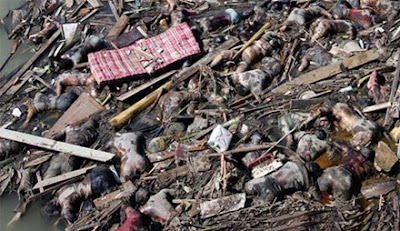
Mass fatality management in Thailand, Sri Lanka, and Indonesia was studied by PLos Medicine. They studied body recovery and storage, identification, disposal of human remains, and health risks from the corpses. The study was conducted using observations from volunteers at the clean-up scene, leader figures, and also other documented studies/observations. This is majorly condensed version of the study:
- Refrigeration of the bodies was not an option immediately following the disaster so temporary burial and dry ice had to suffice.
Some bodies were simply thrown into graves because they were decomposing (the grave would be of cooler temperature) and the issue of disease was at hand (even though there was not any finding of survivors being affected by the corpses physically). This caused the inability to identify victims. The containment of the bodies was chaotic: no one remembered where bodies were taken and relatives didn't know who had taken their loved ones body and where. Proper land to bury the mass amount of remains was a difficult task and typically was done in a haphazard way which made visiting and memorials very difficult to nearly impossible. There was no formal disposal of remains.
- Because of the daily sky-rocketing heat in Thailand, the bodies decomposed quickly which made identification nearly an impossible task. Most identification was done using dental/fingerprint data.
- There was an obvious lack of planning on the federal and local level.
"Emergency response should not add to the distress of affected communities by inappropriately disposing of the victims. The rights of survivors to see their dead treated with dignity and respect requires practical guidelines and technical support."
Sources
Morgan, O.W., Sribanditmongkol, P., Clifford, P., Van Alphen, D., & Sondorp, E. (2006, June 6). Mass fatality management following the south asian tsunami disaster: case studies in thailand, indonesia, and sri lanka. Retrieved from http://www.ncbi.nlm.nih.gov/pmc/articles/PMC1472696/
